
Minor Morris
In “The Look of Love,” Mark Morris takes on the songs of Burt Bacharach

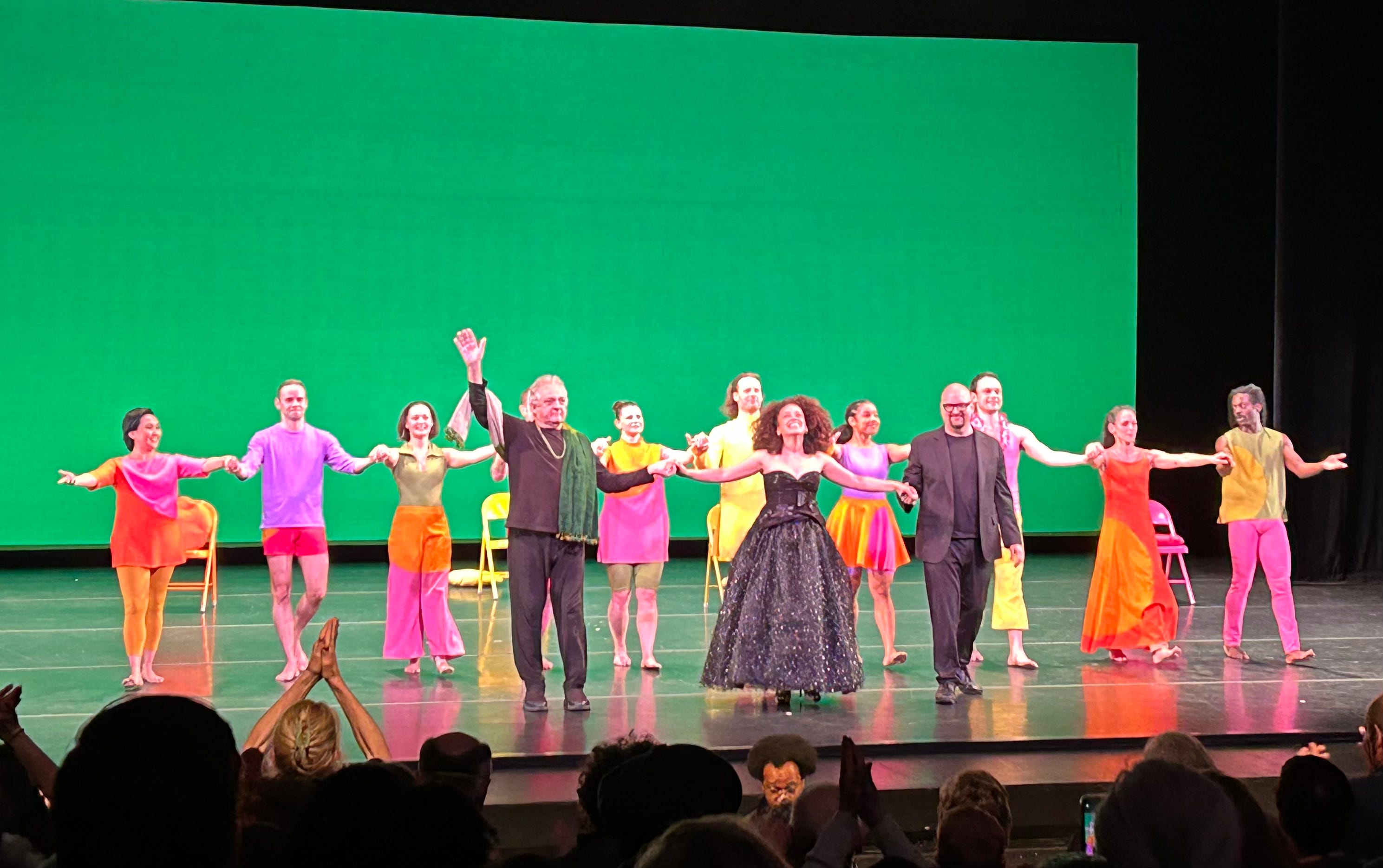
Mark Morris, Marcy Harriell, Ethan Iverson, and the dancers of the Mark Morris Dance Group after “The Look of Love” at the Brooklyn Academy of Music
I didn’t grow up with the songs of Burt Bacharach—with the exception of a toy that played “Raindrops Keep Fallin’ on my Head” on a loop—but I get why songs like “Walk on By” and “Always Something There to Remind Me” are popular. There’s a sunniness to them, a jaunty pulse, an honesty to the emotions they express, that are immediately appealing. They lie right on the edge of easy listening, but never step over. Their blippity-blippity rhythms keep them this side of sentimentality.
Are these qualities I would immediately associate with the choreographer Mark Morris? Not necessarily. Morris has used popular music before, for example in “Pepperland” and “Dancing Honeymoon,” which used popular songs from the 20’s. And a lot of the baroque dance music he has choreographed to in the past could be described as the pop music of its time. Nor is Morris a stranger to sincerity or plainspokenness. One of the most attractive aspects of his dances is the way they avoid grandiosity and falseness. The language of the dance is direct, and so are his dancers, and, almost always, the presentation, the costumes, and everything else.
But every so often he creates a work that feels as if it had been built out of pure craft, without real inspiration. “The Look of Love” (at BAM until March 23) is one of them. His “Rite of Spring” and “Romeo and Juliet” were others. You never quite buy the idea that he loves this music or finds it particularly interesting, or that it draws anything original or inevitable out of him. (In his best dances, the feeling of inevitability is strong.) He has made a respectable dance, because he can’t help it. He has created material, combined it in ingenious ways, allowing us to hear the music more clearly and see, with great clarity, the themes he has set out to explore.
In “The Look of Love,” the themes are couple-dom, and the ins and outs of friendship and love. The dancers pair off, switch partners, go off on their own. Sometimes, they cover their faces in sadness. They lift each other up and then let each other down. Not much attention is paid to gender, or who is doing the picking up. (This is common now, but Morris has been doing it for ages.) The men and women are equally strong, equally vulnerable. There is also a nod to hope, without which love cannot exist. It is most clearly expressed in “I Say a Little Prayer,” in which dancers hold out their arms, or lift them to the sky, as if praying for love and togetherness.
But you get the feeling, from the start, that there was a scarcity of conviction behind the entire enterprise. As always, Morris develops gestures and then reuses them. But here the pool is small, and their re-use excessive. There’s the straight-arm semaphore (up, out, side, down); the ballroom-dance arm undulation, paired with leisurely or super-fast footwork; the open-armed flying; the pneumonia cough; the clenched hands at the heart. There is a fair bit of miming of words, and even lip synching. The fact that these elements are combined in clever ways throughout the dance goes without saying. Morris is a master craftsman. And the specificity of each movement is, as always, very pleasing.
One entire dance, “Walk on By,” is made up of walking steps. This isn’t new for Morris—one of the most exhilarating dances in “L’Allegro, il Penseroso ed il Moderato” is a walking dance set to “As Steals the Morn Upon the Night.” It is like a vision of heaven, and accordingly you hope it will never come to an end. But this walking dance, despite its sharp angles and shifting patterns, variations, changes in tempo, and interruptions, pales in comparison.
The best thing about “The Look of Love” is the way the dance couples effortlessly with the music. Ethan Iverson, arranger and pianist here, has deconstructed the songs, cleaned up each component, and put them back together with wit and taste. They sound great in this arrangement for piano, trumpet, bass, and drums. And the singers are fantastic, both the background vocalists (Clinton Curtis and Blaire Reinhard) and, in particular, the lead singer, Marcy Harriell. Harriell’s voice gleams and whispers, expressing a wide range of emotions, from longing to warmth to fun to the nonchalance of “Do you Know the Way to San José.” She never pushes; the pleasure of singing comes through in every vowel. (The costumes, by Isaac Mizrahi, are also lovely: bright, color-block, unisex separates in pink, yellow, orange. They are a balm to the eye.)
It's nice to see the singers turn around in the orchestra pit to watch the dancers. Music and dancing are part of the same world (so often not the case). And Morris’s dancers merit observation. They are direct, un-fussy, relaxed. Each movement is specific, and falls right in the middle of the beat. There is absolutely no excess. And even though “The Look of Love” allows them less freedom of expression than other Morris works—there is a strange neutrality to their dancing here—some of them nevertheless stand out: Courtney Lopes, for the hunger of her movement; Taína Lyons for her lyricism; Brandon Randolph for the buoyancy of his jump and the emotional complexity with which he imbues each step.
Perhaps it is telling that my favorite number was not the cheerful closer but rather “The Blob,” from Bacharach’s soundtrack for a silly 1958 scifi movie. “Be careful of the blob!” the singers say again and again as we watch the dancers in silhouette. It is a welcome moment of weirdness in what is otherwise a little too neat, a little too pat. It’s still Mark Morris, but it’s minor Morris.
Very cogent - thank you!
Reply to "The Look of Love," Mark Morris takes on the songs of Burt Bacharach: This is a beautifully written review, honest, direct and full of detailed observations of what what does and mostly doesn't work. I especially like the references to the new arrangement of Burt Bacharach's music by Ethan Iverson who "...deconstructed the songs, cleaned up each component , and put them back together with wit and taste." It's an observation reviewers don't often pay attention to.